Kitchen & Cabinet Mold Removal in Perris, CA
Under-sink drips and dishwasher leaks rot cabinet boxes from the inside out — quietly, for months. We find the leak, remove the mold, and rebuild what can't be saved, so your kitchen is actually clean behind the doors.
- Leak source found and fixed — not just the mold
- Cabinet-box rebuild when particleboard can't be saved
- Dishwasher and supply-line leak checks included
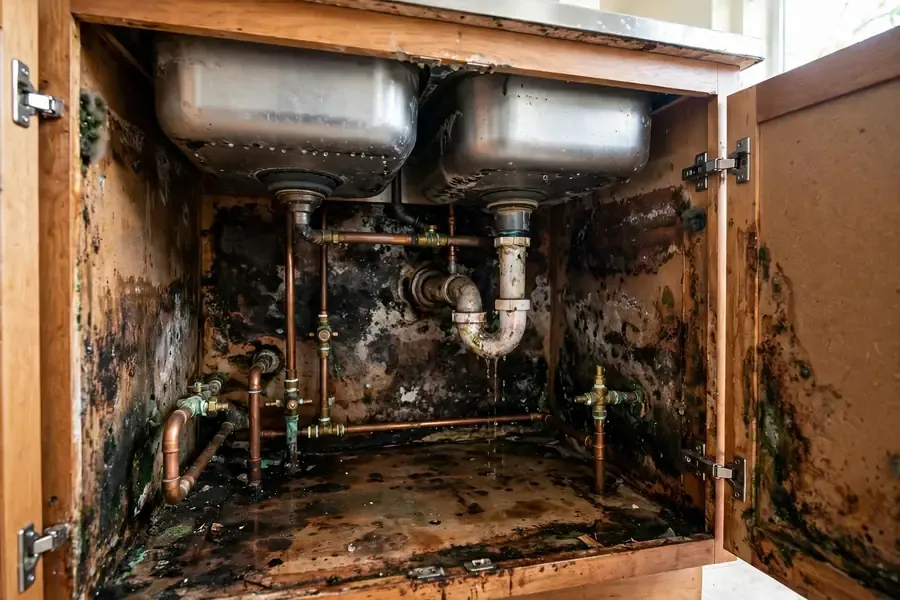
Kitchen & Cabinet Mold Removal in Perris, CA
The kitchen hides mold better than any room in the house. Under-sink cabinets, dishwasher cavities, and refrigerator water lines create slow, hidden leaks — and the particleboard boxes most cabinets are made of are basically mold food once they stay damp. By the time you smell it, the damage is usually further along than you'd guess.
The classic Perris scenario: a slow supply-line drip under the kitchen sink — the kind that leaves the cabinet floor slightly damp for months. Particleboard swells, the paper facing on the cabinet back feeds mold, and because the cabinet doors stay closed, nobody sees a thing until the musty smell gets strong or the cabinet floor feels soft. Dishwasher leaks are the stealthier cousin: a failing door seal or loose drain connection drips a little with every cycle, soaking the subfloor and the adjacent cabinet boxes. Homeowners notice a faint odor or a slightly buckled floorboard long before they think "mold." Refrigerator water lines — the plastic tubing feeding ice makers — are the third classic; when they crack, they spray intermittently behind the fridge where nobody looks for years.
Age matters here. The kitchens in Downtown Perris's mid-century homes have original or decades-old plumbing with supply lines and valves that have been slowly failing for years — and original cabinet boxes that have absorbed decades of minor moisture events. The tract kitchens in Eastgate and May Ranch are newer but built with the same particleboard boxes; a single bad dishwasher install can ruin them in a season. Either way, the fix follows the same logic: find the leak, stop the water, remove what's colonized, and rebuild what can't be saved.
We're Perris Mold Pros. Kitchen jobs need a particular honesty, because the answer is sometimes "this cabinet box can't be saved" — particleboard that's swollen and colonized through doesn't get cleaned, it gets replaced. We'll tell you which it is before we start, in writing, with the price attached. Call (951) 484-2620 — and open that under-sink cabinet and take a good look before we arrive.
Our Kitchen Mold Process
Leak first, mold second, rebuild third.
Leak detection
We trace the water: supply lines, drain connections, dishwasher seals and drain hose, refrigerator water line, and the wall behind. Dye testing and moisture meters find drips you'd never see with the doors open.
Damage assessment
Cabinet boxes, subfloor, and adjacent drywall are assessed honestly — what's cleanable, what needs partial replacement, and what has to come out entirely. You see the photos before we touch anything.
Containment
The kitchen work zone is sealed; HVAC vents covered. Kitchens connect to living spaces, so containment discipline matters here.
Removal & remediation
Colonized particleboard and drywall are removed and bagged; sound wood is HEPA-cleaned and treated; the leak itself is repaired.
Rebuild & prevention
Cabinet boxes are rebuilt or replaced, plumbing connections renewed, and you get guidance on what to watch — including upgrading that plastic fridge line to braided steel.
Why Is There Mold Under My Kitchen Sink?
Because something's been dripping, and particleboard never dries. Under-sink mold is almost always a slow supply-line drip, a drain connection seep, or condensation — feeding on the cabinet box for months behind closed doors. The mold is the symptom; the drip is the disease.
Let's talk about particleboard, because it's the real villain in kitchen mold stories. Most stock cabinet boxes are particleboard — wood chips glued together with resin, faced with paper or laminate. It's cheap, it's everywhere, and it behaves like a sponge: once it gets wet and stays wet, it swells, delaminates, and grows mold through its entire thickness. Here's the part homeowners need to hear: colonized particleboard cannot be cleaned. You can't HEPA-vacuum mold out of swollen, crumbling chipboard — the material itself is compromised. It gets removed and replaced. Solid-wood face frames and plywood boxes are a different story; those can usually be cleaned and saved. An honest contractor tells you which you have before quoting, not after demolition.
The dishwasher leak you don't know about
Dishwashers deserve their own warning because their leaks are so sneaky. A door seal that's lost its compression, a drain hose with a slow seep at the connection, or an over-sudsing cycle that pushes water past the seal — each one deposits a little water per cycle, day after day, into the cavity beside and beneath the machine. The signs are subtle: a faint musty smell when you open the dishwasher, slight buckling of the flooring in front of it, or the toe-kick feeling damp. By the time it's obvious, the subfloor and both adjacent cabinet boxes are usually involved. When we do kitchen mold jobs, the dishwasher cavity gets inspected as a matter of course — it's too common a source to skip.
| Kitchen mold source | Typical signs | Usual fix scope |
|---|---|---|
| Under-sink supply drip | Musty cabinet, damp floor, swollen box | Fix supply line; replace box if colonized through |
| Dishwasher seep | Odor at dishwasher, buckled floor nearby | Reseal/reconnect; subfloor + adjacent boxes |
| Fridge water line crack | Water behind fridge, warped flooring | Replace line (braided steel); remediate wall/floor |
| Drain connection seep | Dampness under drain, slow drip staining | Reseal drain; treat or replace affected box |
One cheap upgrade that prevents the next leak
If your refrigerator still uses the original plastic water line for the ice maker, replace it with braided stainless steel — it's a small job that eliminates one of the most common surprise floods in Perris kitchens. Same logic applies to under-sink supply lines: braided steel connectors with quarter-turn shutoff valves, replaced proactively every decade or so, prevent the slow drips that feed cabinet mold for months unnoticed. We'll flag what we see during the job and tell you what's worth doing now versus later.
Where Mold Hides in Perris Homes
Most of the mold we remediate in Perris isn't the spot you can see — it's the colony behind it. On every job, we check these areas:
Attics
December–February storms exploit aging flashing and tile on Perris’s mid-century roofs. Attic mold is the hidden colony we find most — the musty smell arrives long before any visible spot.
Bathrooms
Failed caulk, slow supply-line drips, and fans that vent into the attic instead of outdoors keep bathrooms damp. Grout and drywall around tubs are the usual starting points.
Kitchens
Under-sink leaks and dishwasher seepage feed mold behind kick-plates for months. Particleboard cabinet boxes in tract and mobile homes wick water and can’t be dried out once swollen.
HVAC & swamp-cooler ducts
Ductwork spreads whatever grows inside it to every room. On older Perris homes, evaporative cooler pads and roof-mounted ducts stay damp all summer — a musty smell when the cooler runs is the tell.
Wall cavities
Pinhole leaks in aging copper and galvanized plumbing feed mold inside walls for months. Bubbling paint, a creeping water bill, or an earthy smell in one room are the early warnings.
Slab edge & flooring
Expansive clay swells with winter rain and shrinks in summer heat, stressing slabs; heavy irrigation against the foundation adds moisture. It wicks up exactly where baseboards and drywall meet the floor.
Related Mold Services in Perris, CA
Mold Remediation
Full containment-based removal per the ANSI/IICRC S520 standard. Our flagship service.
Mold Remediation in Perris, CABathroom Mold Removal
Grout, caulk, ceilings, and exhaust fans — the bathroom mold Perris humidity keeps bringing back.
Bathroom Mold Removal in Perris, CAWater Damage & Mold Restoration
From burst pipe to mold colony — drying, remediation, and restoration in one job.
Water Damage & Mold Restoration in Perris, CAFAQs — Kitchen & Cabinet Mold Removal — Perris, CA
Straight answers, no scare tactics.
Almost always a slow drip — supply line, drain connection, or condensation — that has been wetting the particleboard cabinet box for months behind closed doors. Particleboard acts like a sponge and grows mold through its full thickness. The fix is finding and stopping the drip, then removing what's colonized.
It depends on the material. Solid wood and plywood can usually be HEPA-cleaned and saved. Particleboard that's swollen, delaminated, or colonized through cannot be cleaned — the material itself is compromised and must be replaced. We assess honestly with photos before quoting, so you know which it is up front.
Subtle signs: a faint musty smell when you open it, slight buckling of flooring in front of it, or dampness at the toe-kick. Dishwasher leaks drip a little every cycle — door seals, drain connections, over-sudsing — soaking the cavity unnoticed for months. We inspect the dishwasher cavity as standard on kitchen mold jobs.
The CDC-accurate framing: no study has proven specific illnesses from any mold genus, but kitchens are food-prep areas, and mold plus chronic moisture plus food particles is unsanitary by any standard. Cabinet mold also signals an active leak, which will keep damaging your home until fixed. It deserves prompt, proper remediation.
It varies widely with the extent: a contained under-sink job with a repairable box costs far less than a multi-cabinet dishwasher-leak job requiring subfloor work and box rebuilds. Published Southern California small-job ranges run $600–$2,500 (restoreadvisor.com, October 2026), but kitchen jobs with rebuilds go higher — we quote in writing after inspection.
Yes — addressing the moisture source is part of every remediation we do. Supply lines, drain connections, and dishwasher hookups in our scope get repaired; we also recommend proactive upgrades like braided-steel fridge lines while we're there.
Usually, yes, with the work zone contained. For multi-day jobs involving several cabinets, we'll plan the sequence so you keep a working sink as long as possible — and we'll tell you honestly at the inspection if the scope means a couple of days of takeout.
Check under-sink cabinets seasonally for dampness, replace plastic supply lines with braided steel, don't store cleaning chemicals piled against the back wall (they hide leaks), and fix any drip the day you notice it — not next month. A $15 leak caught early never becomes a $1,500 remediation.
Not if the leak is fixed. Kitchen mold is almost always plumbing-driven — a supply line, drain, or dishwasher connection — so our jobs include identifying the exact source, not just cleaning the visible growth. Fix the water, and the mold has nothing to return to.
Usually not — and this is the exclusion that surprises people most. Insurance covers sudden, accidental water damage (a burst line), not gradual leaks that went unaddressed. A slow under-sink drip that feeds mold for months is classified as a maintenance issue. If you find one, fix the plumbing immediately and document the date.
Musty Under the Sink? It's Probably Worse Than It Smells.
Cabinet mold hides until the box is rotted. We'll open it up, assess it honestly, and fix both the leak and the mold. Serving Perris, Moreno Valley, Menifee, Hemet, and San Jacinto.
- Perris-based — 580 Coliseum St, Perris, CA
- Containment-based process per the S520 standard
- Honest testing guidance — no upsells
Request a Free Quote
Tell us what you're seeing — we'll get back to you shortly.